Yes, you can ride the Bernina train from Milan in winter. The regional red train runs between Tirano and St. Moritz about once an hour in each direction from November to March, and the panoramic Bernina Express keeps two departures a day: PE 972 north from Tirano at 10:06 and PE 975 south from St. Moritz at 15:30. Guided day trips from Milan keep running through the season.
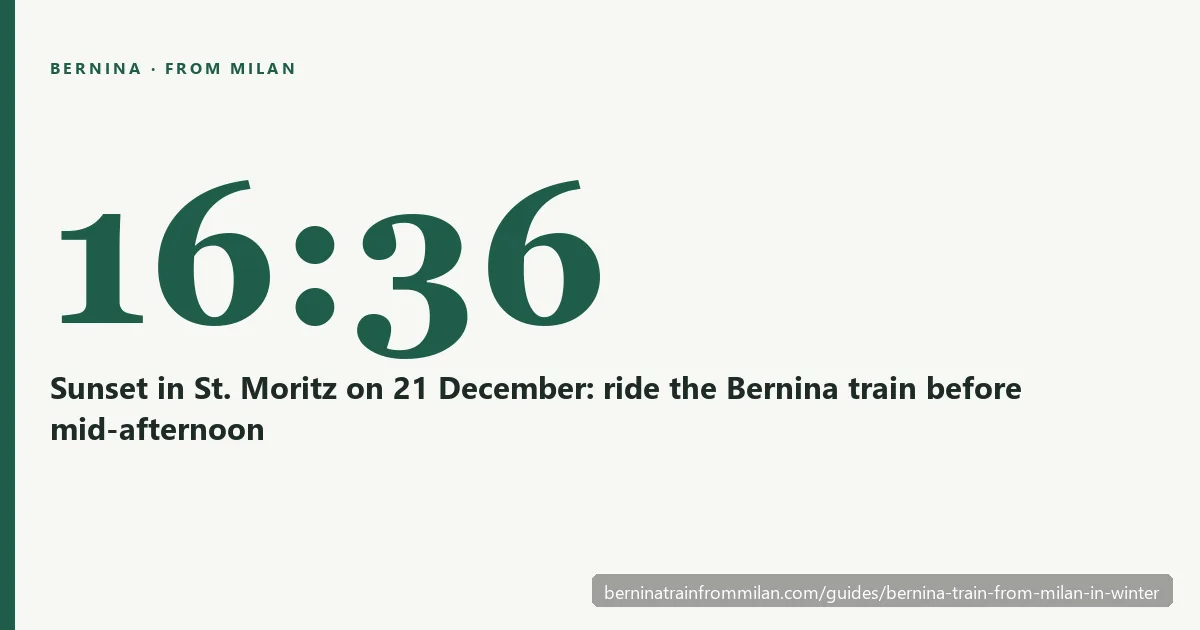
What changes is the light. On 21 December the sun sets in St. Moritz at about 16:36, so a train that leaves the mountains after mid-afternoon finishes its ride in dusk or darkness.
For a winter day, choose a tour or a train that puts you on the line between late morning and early afternoon, dress for temperatures well below freezing at the top, and carry your passport or ID card for the two border crossings.
Milan: Bernina Train & St. Moritz Day
What runs on the Bernina line in winter
The Rhaetian Railway (RhB) runs the line every day of the year, and trains have kept running through the winter since 1913–14. Two kinds of train share the track, and the Bernina Express vs red train guide covers the differences in full.
The red train is the ordinary regional train with windows you can open. In winter it runs about once an hour each way, alternating faster RE9 trains (about 2 h 11 min to 2 h 14 min between Tirano and St. Moritz) and slower R19 trains (about 2 h 30 min). On the January timetable the last through train from St. Moritz to Tirano leaves at 16:48. You need only a ticket; a seat reservation is optional at CHF 5 per person.
The Bernina Express needs a ticket plus a seat reservation, about CHF 32 per person each way between St. Moritz and Tirano. Swiss Travel Pass, Eurail and Interrail holders and children pay that reservation in full. These are the winter departures on the St. Moritz–Tirano section:
| Train | Leaves | Arrives | Runs |
|---|---|---|---|
| PE 972 | Tirano 10:06 | St. Moritz 12:35 | Daily |
| PE 975 | St. Moritz 15:30 | Tirano 18:00 | Daily |
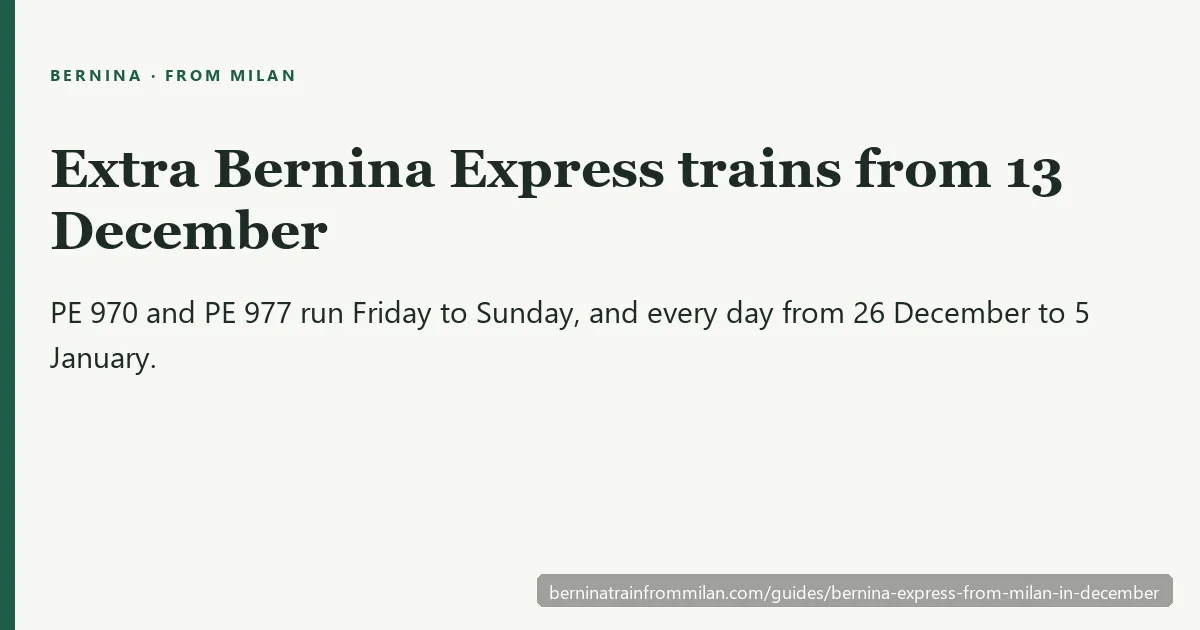
| PE 970 | Tirano 09:18 | St. Moritz 11:45 | Fri–Sun from 13 Dec; daily 26 Dec–5 Jan |
| PE 977 | St. Moritz 16:14 | Tirano 18:50 | Fri–Sun from 13 Dec; daily 26 Dec–5 Jan |
So from November to 12 December you get one Bernina Express up and one down each day. From 13 December the extra pair runs Friday to Sunday until 23 April 2027, and every day over the Christmas holidays. The December changes have their own page: the Bernina Express from Milan in December. Check times for your date on rhb.ch or in the SBB app.
Daylight: ride before mid-afternoon
These are flat-horizon times. In the deep valleys around Poschiavo and Brusio the sun drops behind the ridges earlier than the clock suggests.
| Date | Place | Sunrise | Sunset |
|---|---|---|---|
| 13 December | Tirano | 07:53 | 16:34 |
| 21 December | Milan | 07:59 | 16:42 |
| 21 December | St. Moritz | 08:01 | 16:36 |
| 12 January | St. Moritz | 08:02 | 16:54 |
| 15 February | Tirano | 07:24 | 17:43 |
A northbound train from Tirano in the morning climbs the whole line in daylight: PE 972 reaches St. Moritz at 12:35, and red trains leaving Tirano between 08:58 and 11:00 arrive between 11:11 and 13:11. A southbound afternoon train is a different trip in December and January. PE 975 passes Alp Grüm at about 16:40, around sunset, so the descent through Val Poschiavo and round the Brusio spiral viaduct runs in the dark. A red train leaving St. Moritz at 14:48 reaches Tirano at 17:00, also after sunset, which means you see the lower valley in fading light.
This matters for tours, because many Milan day trips drive to St. Moritz first and ride the train down in the afternoon. The Frigerio Viaggi listings say it themselves: from late October to late February, early sunsets can cut visibility on the afternoon train. By mid-February sunset in Tirano is at about 17:43, an hour later than in late December.
Whichever order you pick, every coach day trip drives back to Milan in the dark from December to February.
Other experiences
Other Bernina train trips from Milan
More Bernina train, St. Moritz and Lake Como day trips from Milan. Open any of them to see which winter dates are on sale.
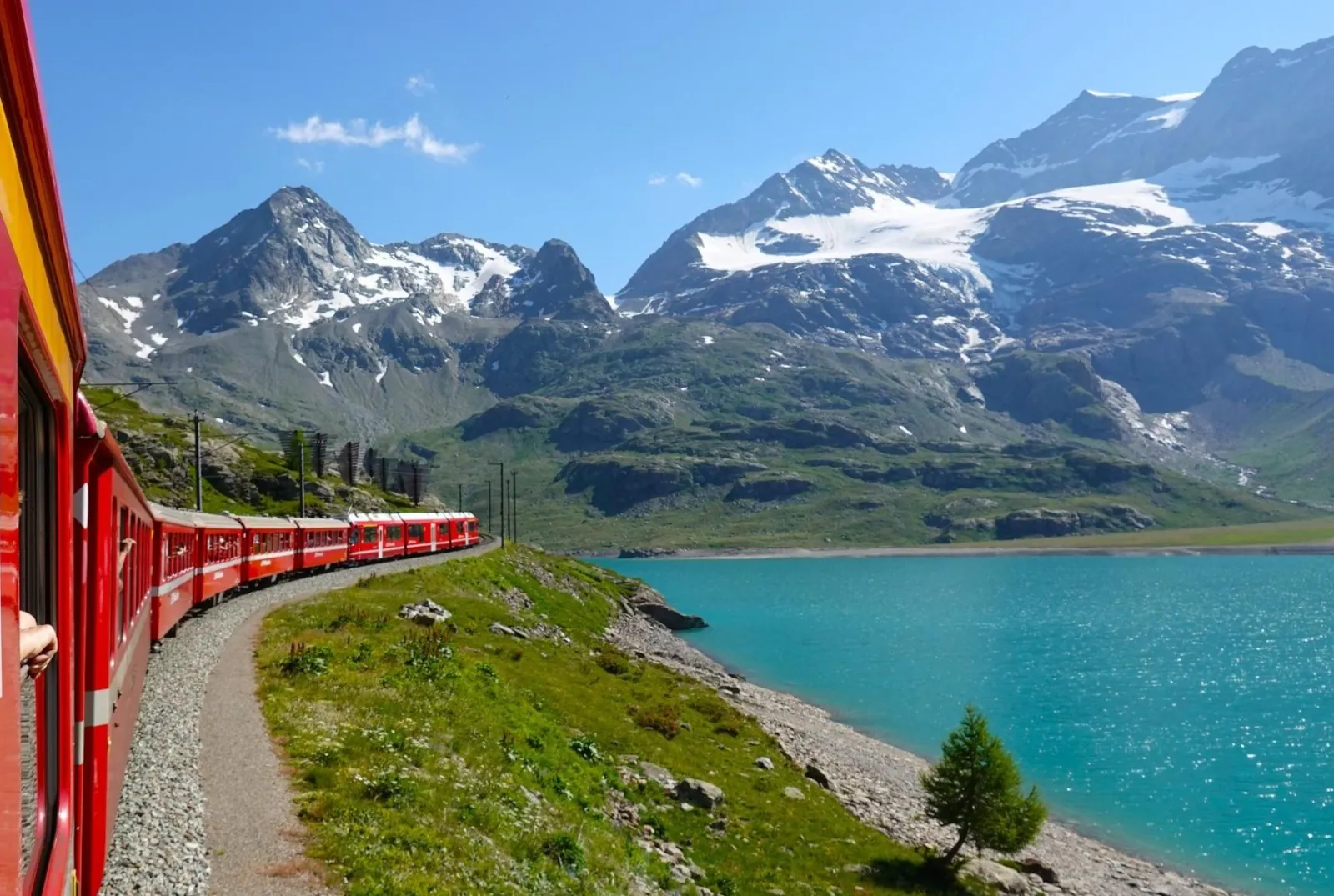
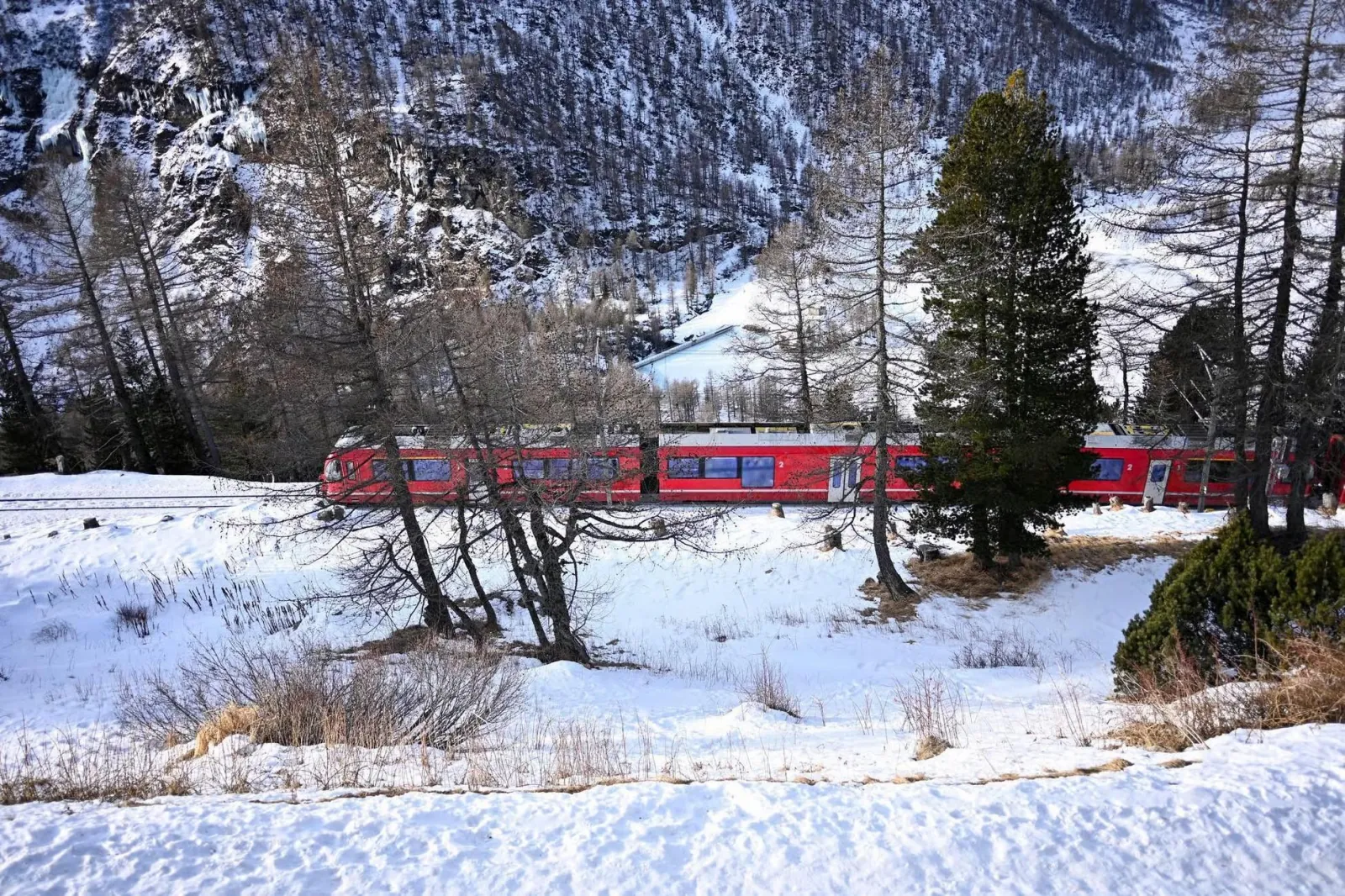
Snow and cold on the line
The top of the line at Ospizio Bernina sits at 2,253 m, the highest point on the RhB network, and Tirano is at about 430 m. In one ride you climb about 1,800 m, from the Italian valley floor into high Alpine winter.
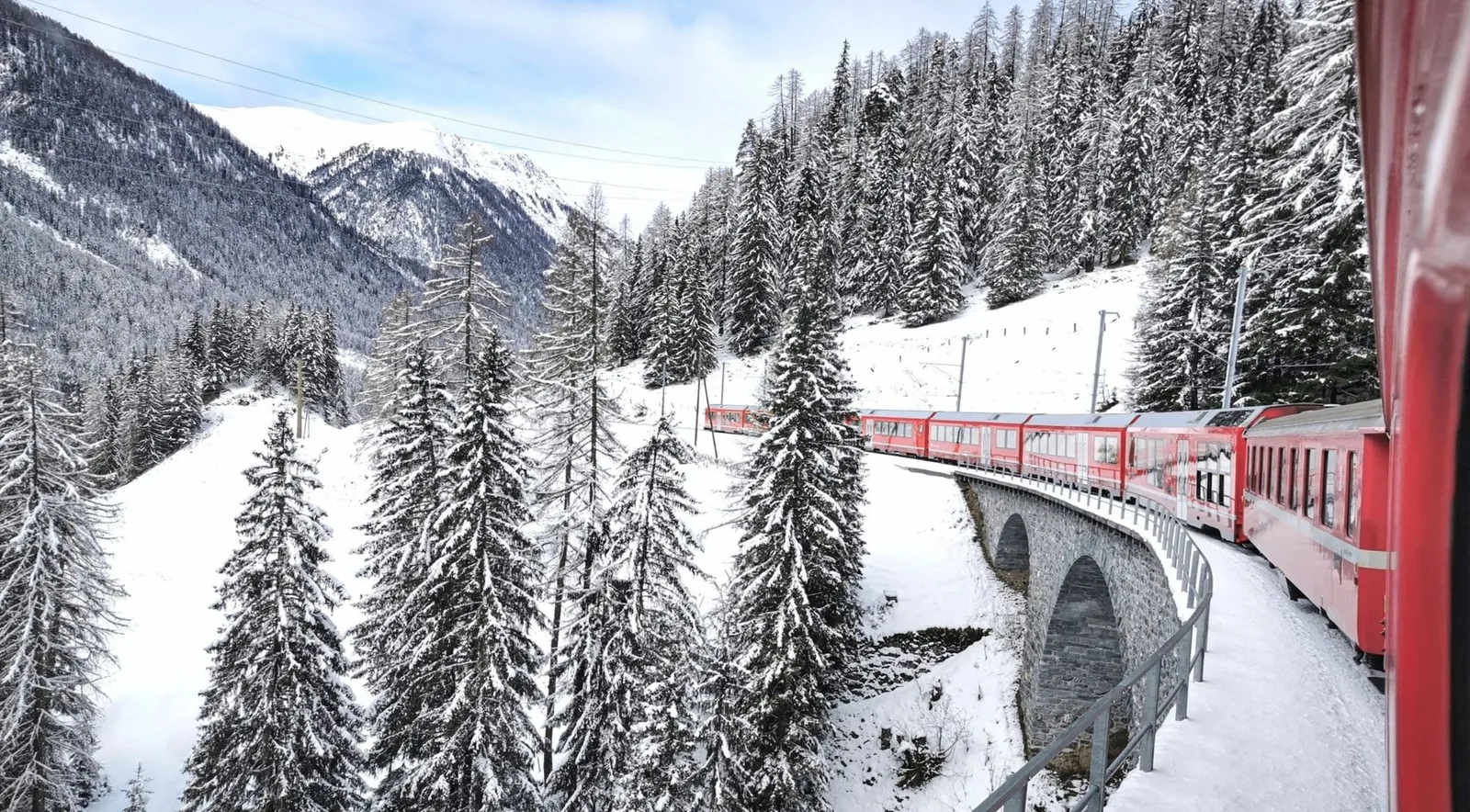
Heavy snowfall and strong winds at Ospizio Bernina and Lago Bianco are normal in winter, according to the Swiss snow and avalanche institute. Wind drives snow back onto the tracks, so RhB clears the line with ploughs, rotary blowers and, often, by hand, and has added snow fences and wind baffles near Lago Bianco. The line has still closed in the past. Expect delays after a big snowfall and keep the evening of your trip free.
Weather records for Samedan, the station near St. Moritz, show an average December high of about −0.7 °C and an average low of about −13.4 °C (1991–2020), and January runs slightly colder. Ospizio Bernina, higher up the line, is colder still. How much snow you see changes week to week, and no tour can promise a white landscape. Look at the MeteoSwiss forecast for Ospizio Bernina a day or two before you go.
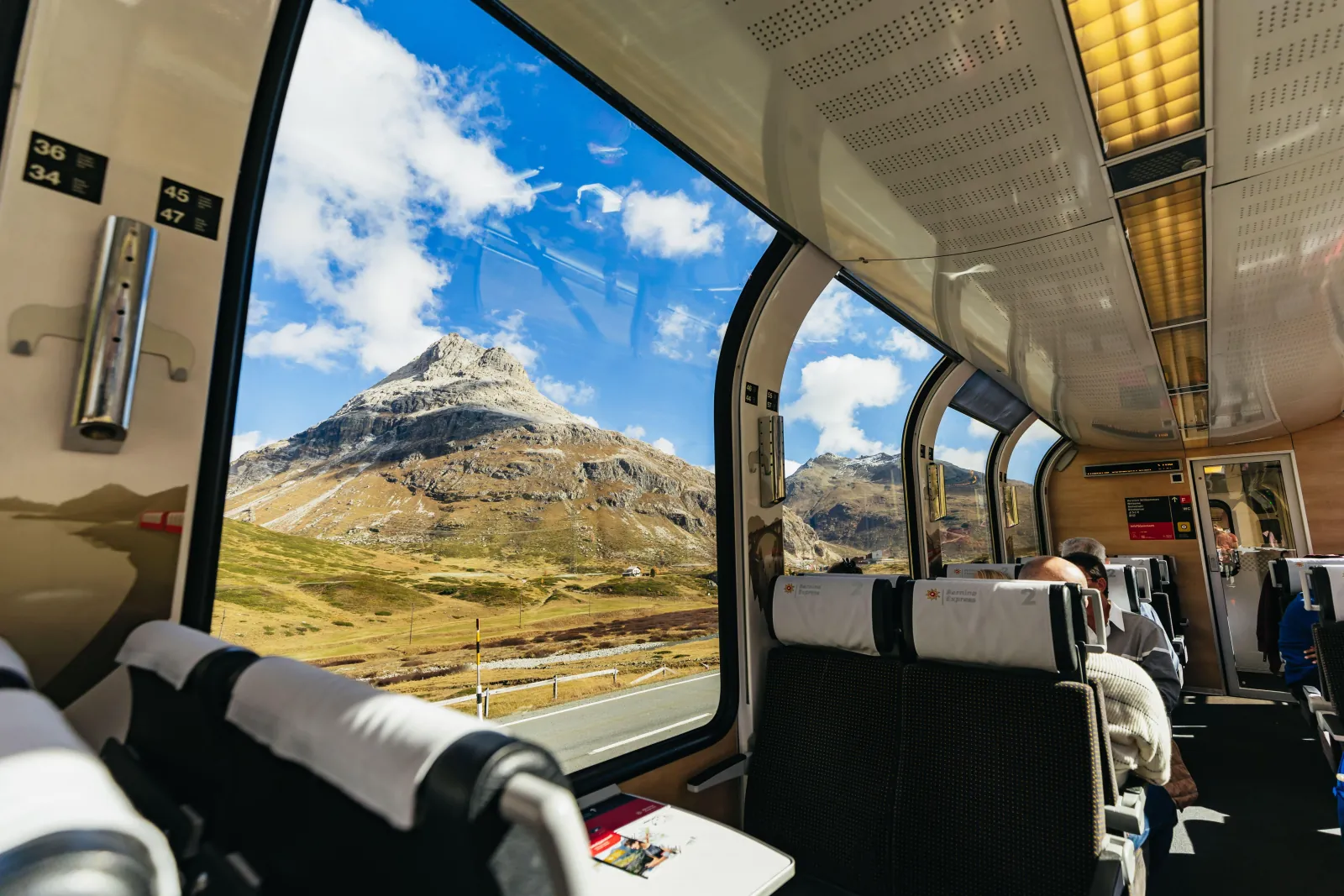
On the red train you can open the window for photos without reflections, its main advantage in winter. Keep it brief, because the air is freezing. The Bernina Express windows do not open and reflections often show up in photos, though the glass curving into the roof shows the peaks overhead.
Roads, passes and coach day trips
Every Milan day trip covers most of its distance by road. Coaches usually use the Maloja Pass (1,815 m) between Chiavenna and St. Moritz, and some cross the Bernina Pass road (2,328 m). Both roads stay open all year. Winter tires are compulsory on both for the whole winter, chains may be required for short spells, and either pass can close at short notice after heavy snow. The Bernina Pass road closed for several days in January 2025, for example.
On your trip that means three things. The day can run in a different order: the Milan to the Swiss Alps red train day trip (our review) can run in reverse or change for weather, traffic or railway operations, and the St. Moritz and Alps day trip by City Wonders (our review) says the same. The day can run long. And a trip can be cut short: in severe weather, or if the train runs only part of the way, the small-group Bernina red train day trip (our review) either cancels with a refund or runs a shorter ride that skips the highest point or St. Moritz.
Traveling on your own by train avoids the passes entirely. The Trenord line from Milan to Tirano follows Lake Como and the Valtellina floor, and from Tirano the red train does the climbing.
Which Milan day trips suit winter
The tour that best fits a short winter day is the one that rides the train early. These are the main options, with prices on dates checked on 12 November 2026:
| Tour | Train | When you ride | Time in St. Moritz | From |
|---|---|---|---|---|
| Autostradale Bernina train and St. Moritz day trip | Red train, 2nd class | Usually Tirano up, first half of the day | About 1.5 h | $158 |
| Milano Art Discovery red train day trip | Red train | Usually Tirano up, first half of the day | About 1.5 h | $131 |
| Zani Viaggi St. Moritz tour with guide | Red train, 2nd class | St. Moritz down, afternoon | About 2 h | $165 |
| Frigerio Viaggi St. Moritz and Bernina Express | Panoramic coach (option) | St. Moritz down, afternoon | About 1.5–2.5 h | $185 |
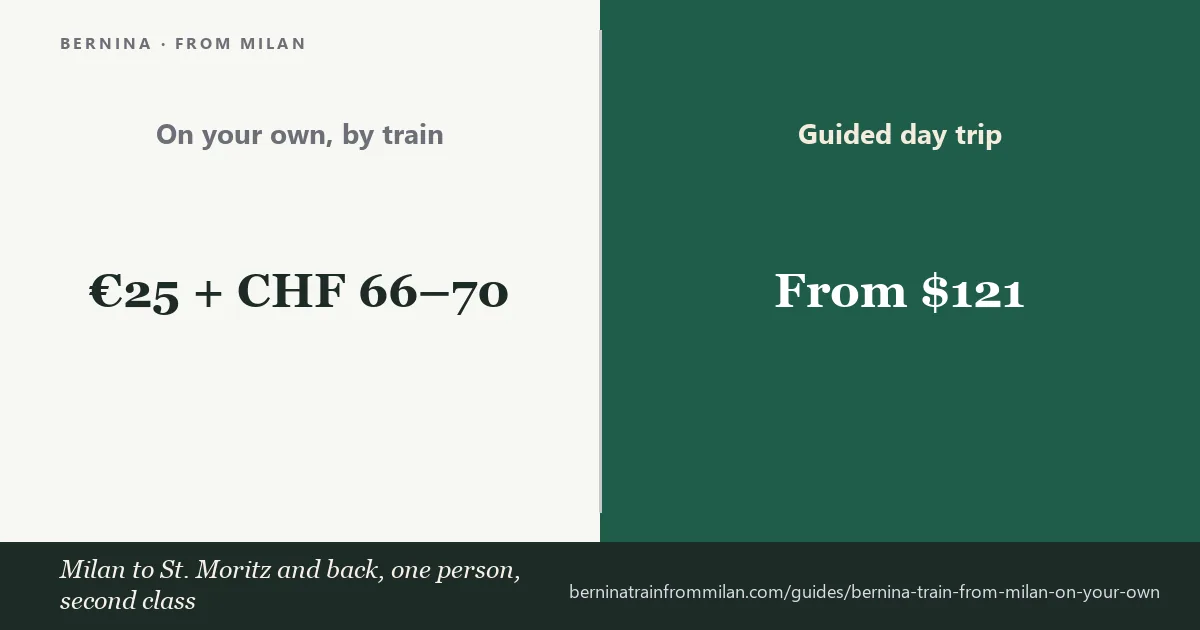
| Tirano–St. Moritz return ticket | Red train | Your choice | Your choice | $121 |
The Bernina train and St. Moritz day trip from Milan (our review) is the featured pick here. The coach takes you through the Valtellina to Tirano, the red train climbs to St. Moritz in daylight, and you return over the Maloja Pass after about an hour and a half in town. It costs from $158 per person and is rated 4.5 from 5,070+ reviews. The operator can run the train the other way, and on some dates it uses the Albula line to Thusis, so read your booking.
The Milano Art Discovery red train day trip follows the same order for $27 less, with a 4.8 rating from 5,110+ reviews and about 45 minutes in Tirano before the train.
The Zani Viaggi tour with guide (our review) gives you more time in St. Moritz but rides the train in the afternoon. The Frigerio Viaggi St. Moritz and Bernina Express tour (our review) is the most-reviewed tour on this site that can guarantee a seat in a panoramic coach, on its Tour with Panoramic Carriage option, and it too rides south in the afternoon. Both suit the second half of February better, when sunset in Tirano comes after 17:40; in December and January, favor the morning trips. For the full field, see the best Bernina train tours from Milan.
A winter day on your own by train
On your own you choose the light. On the current Trenord pattern a 06:20 train from Milano Centrale reaches Tirano at 08:52. The R19 at 09:41 then gets you to Alp Grüm at 11:06 and St. Moritz at 12:11, all in daylight. The RE9 at 08:58 is faster, but a 6-minute change across the square is risky if your Italian train runs late.
For the return, the R19 at 15:48 from St. Moritz reaches Tirano at 18:23, leaving 45 minutes for the 19:08 to Milan, which arrives at 21:43. Trenord times can shift at the mid-December timetable change, so check trenord.it before you go.
The Tirano–St. Moritz red train return day ticket (our review) costs from $121 per person and lets you hop off at any station, so you can stop at Alp Grüm for the Palü glacier view. The step-by-step plan is in the Bernina train from Milan on your own, and the Milan to Tirano train guide covers the first leg.
What to pack for a winter day
- Passport or national ID card. Every Milan day trip crosses the Italian–Swiss border twice, and operators require the document.
- A warm winter jacket, hat, gloves and scarf, even if Milan feels mild. The small-group trip’s packing list names the same for winter.
- Boots with a good grip for icy sidewalks in St. Moritz and on the platform at Alp Grüm.
- Sunglasses. Sun on snow is bright at 2,000 m and more.
- Food and water. Neither the Trenord train nor the red train has catering.
- Some Swiss francs or a card for St. Moritz; Tirano is in Italy and uses euros.
Frequently asked questions
Does the Bernina Express run in winter?
Yes. The Bernina Express runs every day in winter, with PE 972 from Tirano at 10:06 and PE 975 from St. Moritz at 15:30. From 13 December two more trains run Friday to Sunday, and daily from 26 December to 5 January. The regional red train runs about once an hour each way all winter.
What is the Bernina Express winter timetable?
Between Tirano and St. Moritz: PE 972 Tirano 10:06 to St. Moritz 12:35 and PE 975 St. Moritz 15:30 to Tirano 18:00, daily. PE 970 (Tirano 09:18) and PE 977 (St. Moritz 16:14) add Friday-to-Sunday and holiday runs from 13 December 2026. Check rhb.ch for your date.
Is the red train a good choice in winter?
Yes. It runs about once an hour, so you can ride in the best light, and its windows open for photos without reflections. Red-train day tours with a review on this site start at $121 per person, with City Wonders’ day on the Bernina or Albula line depending on the option, and a return ticket from Tirano costs from $121.
Can snow cancel a Bernina train day trip from Milan?
It can change one. The Maloja and Bernina pass roads are open all year but can close at short notice after heavy snow, and tours can reverse or shorten the day. Some operators cancel with a refund in severe weather, so read your listing’s weather terms.
How cold is the Bernina line in winter?
Near St. Moritz the average December high is about −0.7 °C and the average low about −13.4 °C. Ospizio Bernina, at 2,253 m, is colder still. Dress for well below freezing.
Pick your day over the Alps
Most day trips from Milan ride the regional red train; only some sell a guaranteed seat on the panoramic Bernina Express. Check what your date offers.
Check dates and prices